
Heraion of Samos – The Largest Temple of Ancient Greece Dedicated to the Goddess Hera
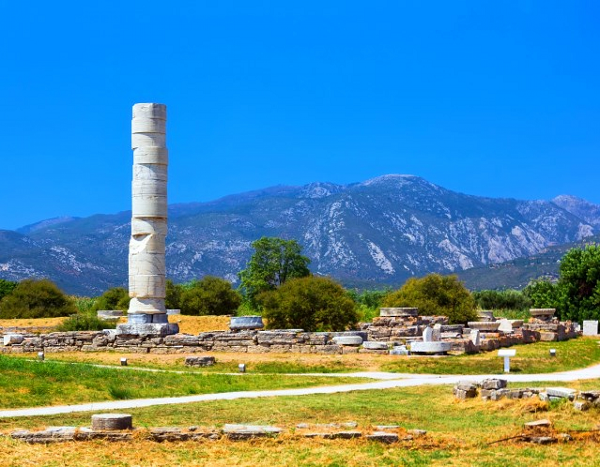
Just outside today’s Heraion village, in southern Samos, among poplar trees, olive groves, and archaeological silence, stands a single upright column. It is all that remains of an architectural wonder of antiquity: the Temple of Hera, known as the Heraion of Samos.
It was the largest temple ever built in ancient Greece, dedicated to the great Olympian goddess, and a place of worship with international influence stretching from Asia Minor to Egypt.
🏛️ One of the holiest sites of the ancient world
The Heraion was not simply a temple, but a vast sacred complex that functioned for more than a thousand years, from the Mycenaean period (2nd millennium BC) through to Roman times. According to tradition, Hera was born there, beneath a sacred willow tree that was worshipped for centuries. Samos did not merely host the goddess — it claimed her as its own.
🏗️ The architectural “giant” of ancient Greece
The monumental temple of the 6th century BC, designed by the architects Rhoikos and Theodoros, measured approximately 108 meters in length and 55 meters in width, with 155 columns arranged in a double colonnade — dimensions that surpassed every other Greek temple of the time. It was among the first large temples built entirely of stone and is considered a milestone in the development of the Ionic order. Sadly, the temple was destroyed relatively early, most likely by an earthquake, and was never fully restored.
🌍 An international pilgrimage center
The Heraion was famous throughout the ancient world. Merchants, kings, and travelers left valuable offerings: statues from Egypt, bronze objects from Asia Minor, jewelry, weapons, and votive gifts that reveal how extensive Samos’ network of contacts truly was. This was not just a religious center, but a hub of cultural and commercial exchange.
🏺 What visitors see today
Today, besides the impressive standing column, visitors can walk among the foundations of successive temples, the remains of stoas, altars, and auxiliary buildings of the sanctuary. The site is open, flat, and ideal for slow exploration, with information panels explaining the long historical development of the sanctuary. A short distance away is the Archaeological Museum of Samos, where many finds from the Heraion are displayed.
🏛️ UNESCO World Heritage Monument
The Heraion of Samos has been designated a UNESCO World Heritage Site, together with Pythagoreion, confirming the global importance of the site. It is not merely another attraction, but part of the world history of architecture and worship.
🌿 An experience beyond the ruins
The atmosphere of the site is almost ceremonial. The ancient Imbrasos River that once flowed beside the sanctuary, the reeds, the olive trees, and the open plain create a feeling of isolation and calm. It is not difficult to understand why this location was chosen as a place of divine presence.
📍 Location
Just outside the modern seaside village of Heraion, in southern Samos, amidst poplars, olive groves and the silence of antiquity, stands a solitary column. It is all that remains of one of the greatest architectural wonders of ancient times: the Temple of Hera, known as the Heraion of Samos.
This was the largest temple ever built in ancient Greece, dedicated to the great Olympian goddess Hera — a sanctuary of pan-Hellenic and international significance, revered from Asia Minor to Egypt.
| From | Distance | Time |
|---|---|---|
| Heraion (village) | 1.5 km | ~5 min |
| Pythagoreio | 6 km | ~10 min |
| Samos Town (Vathy) | 15 km | ~25 min |
| Samos Airport | 13 km | ~20 min |
Access is easy by paved road, with parking and clear tourist signage.
🏺 Prehistory & Sacred Use of the Site
The site has been inhabited since the Neolithic era (5th millennium BC), and during the Middle and Late Bronze Age it was home to a fortified settlement with large buildings.
By 1700 BC, continuous religious activity is documented, including altars, paved areas, Minoan-style conical cups, and Mycenaean influences — all indicating that the site was sacred centuries before the grand temple was built.
🧱 The Temple of Hera – An Architectural Epic
Historian Herodotus called it “the greatest temple in Greece” — and rightly so.
Chronology & Phases:
🔸 Hekatompedos A (8th c. BC)
🔸 Hekatompedos B (7th c. BC)
🔸 Temple of Rhoikos and Theodoros (6th c. BC – during Polycrates’ rule)
🔸 Dipteros I & II: the most famous version (575–520 BC)
🔸 Roman phase: used as a gallery, not a place of worship
Structure:
🏛️ Ionic Dipteros with 105 columns
Column height: over 20 meters (only one remains today at ~11 m)
Made of limestone and marble
Complex drainage system with clay pipes
The temple was never fully completed
✝️ Religious & Political Importance
The temple was more than a sacred place. It was a hub of cultural, spiritual, and political power:
✔️ Offerings from all over the Greek and Eastern world – Cyprus, Asia Minor, Egypt, the Levant
✔️ The cult of Hera in Samos rivaled Delphi in prestige
✔️ A paved Sacred Way led from the city of Samos (Pythagoreio) to the temple, lined with dedications
🎨 Archaeological Findings
Fragments of statues
Cult statue of Hera (possibly by Smilis, ~700 BC)
Inscriptions, dedications, votive offerings
Precious artifacts exhibited at the Archaeological Museum of Samos (Vathy)
🔍 Excavations
First systematic excavations in 1902–1903 by Kavadias & Sofoulis
From 1910 onward, German archaeologists continued the research
Since 1925, under the German Archaeological Institute (DAI) with support from Greek authorities
The entire sanctuary complex has been uncovered, including temples, altars, auxiliary buildings, and rare architectural elements
✨ Visitor Experience
✔️ Free roaming among ruins, with signs and footpaths
✔️ Remains of the temple and Sacred Way are visible
✔️ The standing column is among the most photographed images of Samos
✔️ A must-see for history lovers, photographers, and cultural travelers
📷 Suggested Images
| Subject | Description |
|---|---|
| 🏛️ Standing column | Symbol of the Heraion |
| 🪨 Foundations | Reveal the monumental scale |
| 🌿 Landscape | Fusion of nature and ancient ruins |
| 🛤️ Sacred Way | Stone-paved path leading to the temple |
❤️ Why Visit the Heraion of Samos?
✅ It is the largest ancient temple in Greece
✅ The cult of Hera had international influence
✅ The site is atmospheric, tranquil, and full of mystery
✅ It complements nearby visits like Pythagoreio and the Tunnel of Eupalinos
✅ One of the most iconic landmarks of the island
🔍 Additional Insights
🏺 A Sacred Land Through the Ages
The area surrounding the Heraion was an ancient place of religious worship. Archaeological evidence indicates that the location was inhabited as early as the second half of the 5th millennium BC, during the Neolithic period.
 During the Middle and Late Bronze Age, it was home to a fortified settlement featuring large residential buildings and public structures, highlighting its long-term significance as both a residential and sacred site.
Information about the religious practices during the Bronze Age remains limited, and there is no clear evidence of uninterrupted continuity in ritual activity following the abandonment of the settlement.
However, key findings in the Altar Zone of the sanctuary suggest early sacred use:
a. A first paved floor dated to 1700–1600 BC, containing conical cups resembling those used in Minoan religious practices
b. A second paved layer from the Mycenaean period (ca. 1445/1415–1000 BC), with signs of an altar constructed with mud bricks
c. The first stone altar, securely dated to ca. 1000 BC
🏛️ Temples Through Historical Eras
In the historical period, the sanctuary became the focal point of systematic and evolving worship, evidenced by the remains of at least four different temples:
Hekatompedos A – 8th century BC
Hekatompedos B – 7th century BC
The temple of Rhoikos and Theodoros – 6th century BC, during the tyranny of Polycrates
The monumental Dipteros, dating from 538–522 BC — the structure largely preserved today
Additionally, there were Roman-period temples, built after the Classical era
One of the most important elements was the cult statue of Hera, believed to be the work of the legendary sculptor Smilis, and dated to the early 7th century BC. According to the German archaeologist D. Ohly, it was likely placed inside the second Hekatompedos.
🧱 Architectural Development & Roman Transformation
The Greek historian Herodotus famously wrote that the Heraion of Samos was “the largest temple in Greece.”
Excavations confirm that the structure was a dipteral temple of Ionic order, surrounded by 105 columns. Only one column remains standing today, though not complete — preserved at a height of approximately 11 meters.
The monumental temple replaced the earlier Hekatompedos B (7th century BC), though it was built in a different section of the sanctuary.
The first construction phase (Dipteros I) began around 575 BC, using limestone
Due to poor foundations and a destructive fire, it was rebuilt between 530 and 520 BC (Dipteros II)
The second phase included marble elements, and the outer colonnade featured unfluted columns
Despite its scale and ambition, the temple was never fully completed.
During the Roman period, the temple ceased to function as a place of worship. It was repurposed as a gallery (pinakotheke), while the cult of Hera was relocated to a smaller pavilion temple built by Emperor Augustus, positioned near the original altar and base of the old cult statue.
One remarkable feature of the site is the presence of an extensive clay drainage system, designed to collect and manage rainwater — a testament to the advanced engineering of the time.
✨ Cult Influence, Sacred Way & Excavations
Artifacts found at the Heraion and displayed in the Archaeological Museum of Samos (Vathy) show that the sanctuary of Hera had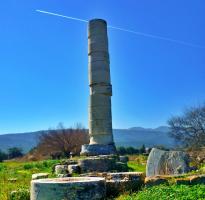 a wide-reaching religious influence:
Offerings came not only from Samos and other Greek regions, but also from Cyprus, Asia Minor, Egypt, and the broader Near East
Its significance rivaled even the Oracle of Delphi, marking it as a true international center of worship
Part of the temple complex is the Sacred Way (Hierá Hodós) — a stone-paved road that once connected the city of Samos (modern-day Pythagoreio) to the temple. It was lined with dedications, monuments, and treasures, many of which have been uncovered.
⛏️ A Century of Excavations
Excavations at the Heraion began over 125 years ago and are still ongoing.
The first systematic archaeological research was conducted in 1902–1903 by the Greek Archaeological Society under the supervision of Panagiotis Kavvadias and Themistoklis Sofoulis
Since 1910, German archaeologists have led the efforts, and since 1925, the site has been excavated and studied by the German Archaeological Institute (DAI) in cooperation with Greek authorities
To date, almost the entire sanctuary has been revealed — including the main temple, altars, smaller temples, residences, and countless artifacts, painting a vivid picture of a flourishing ancient civilization.
The cult of Hera of Samos was not only panhellenic — it spread across the ancient world, as proven by the variety and origin of votive offerings discovered on site.


Add new comment