
Agios Konstantinos of Samos
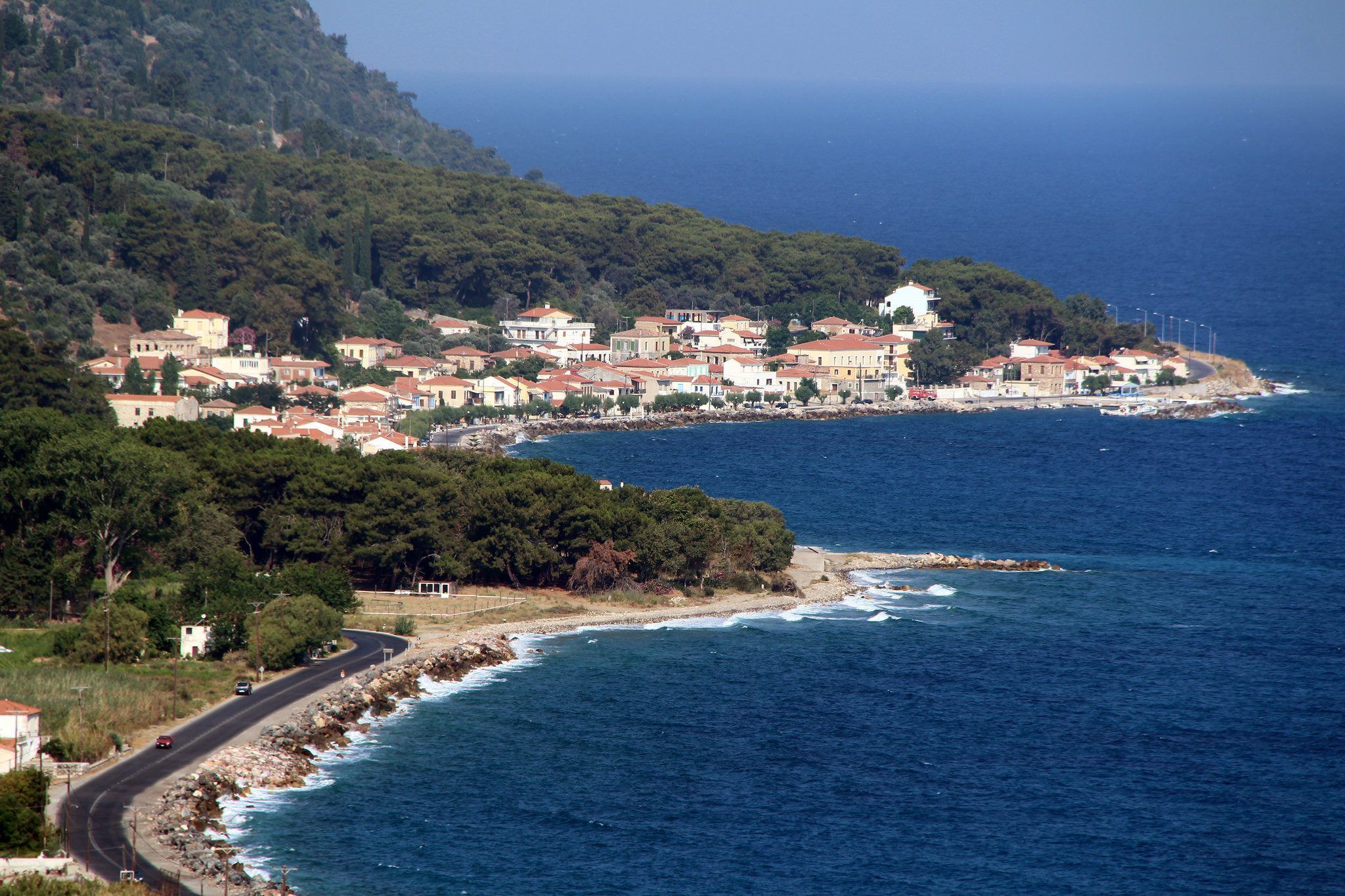
🏘️ Agios Konstantinos of Samos – Between History and the Sea
📍 Location & Settlement Structure
Agios Konstantinos is a seaside village on the northern coast of Samos, located about 20 km from the town of Samos and 10 km from Karlovasi.
It is made up of two settlements: the coastal Agios Konstantinos (formerly known as Ormos Agiou Konstantinou) and the present-day Upper Agios Konstantinos.
The local community also includes the nearby settlement of Valeontades.
It is classified as a semi-mountainous rural area with a surface of 1.286 km² (2011 census).
🕰️ Historical Background
The exact origin of Agios Konstantinos is not clearly documented.
It likely emerged toward the end of the 18th century, as part of the expansion of the population from the nearby village of Vourliotes — the only historically verified village of the greater region, already mentioned by Iosif Georgirinis (c. 1670) and Tournefort (1702).
By the early 19th century, several settlements had developed in the area, with the largest among them being Agios Konstantinos, Nenedes (modern Ampelos), Stavrinides, Manolates, Margarites, and Valeontades.
During the Hegemony period (1834–1912), these villages formed the Municipality of the “Six Neighborhoods” (Exi Geitonies).
👥 Population & Economy
According to an 1828 census, Agios Konstantinos had 254 inhabitants — 112 men and 142 women.
At the time, the main settlement was in the area of today’s Upper Agios Konstantinos, while the coastal zone began forming as a wine storage and trade hub.
By the 1920s, thanks to the flourishing viticulture in the area, the population exceeded 600, and by the end of that decade it reached around 800, including a notable number of refugees from Asia Minor.
In the 19th and early 20th century, the local economy was predominantly agricultural.
Although Tournefort had described the northern-central part of Samos as largely forested in 1702, by 1828 Agios Konstantinos alone was producing 8,000 loads of wine (known as “gomaria” — the load of a pack animal), while the neighboring Vourliotes produced an equal amount.
Viticulture remained the dominant activity throughout the centuries, followed by olive cultivation and fruit trees.
📜 Social & Professional Profile (1914)
According to the 1914 electoral register:
61 were farmers
16 sailors
10 merchants
4 café owners
3 grocers
2 butchers
2 teachers
1 doctor
1 hotel worker (employed in the capital)
Artisans included: 4 carpenters, 1 picture framer, 3 chair-makers, 2 barrel-makers, 2 blacksmiths, 2 millers
1 shipbuilder (kalafatis)
The village also had priests, as well as state employees passing through — such as police officers, customs guards, and rural guards.
Women were typically registered in civil records as “housewives” or performing “women’s work,” although in reality they actively participated in farming and other forms of labor.
📉 Demographic Evolution & Migration
Following World War II, the population of Agios Konstantinos began to gradually decline.
By 2001, the village had 394 registered residents.
This depopulation was due in large part to waves of migration — to America in the early 20th century, to Australia after 1950, and to Athens in later decades.
Today, the economy of Agios Konstantinos relies primarily on agriculture and tourism.
🏠 Traditional Architecture
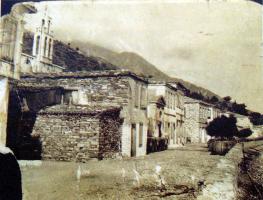
It is difficult to accurately reconstruct the architectural image of Agios Konstantinos around the year 1800, since the oldest known photographs of the village date about a hundred years later.
However, it is reasonable to assume that many of the buildings seen in the early 20th-century photos were already quite old.
These images show a dense, linear settlement stretched along the coastline.
Most buildings were two-story structures, though single-story houses were also present.
The ground floor was built from stone.
The oriental–Asia Minor influence — understandable, given that Samos belonged to the Ottoman Empire until 1912 — is visible in the use of an overhanging upper floor (sachnisi), constructed from light materials like wooden boards coated with lime plaster (known as “tsati” or “tsatmas”).
These upper floors had two to four windows but no enclosed veranda with glass, possibly due to harsh weather conditions.
The roof was tiled, and the first floor’s interior walls were built with thin wooden frames and coated in lime plaster (bagdadi technique).
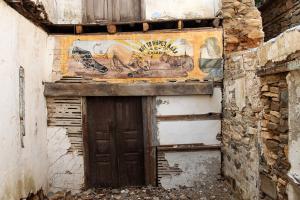
The ground floor (katoi) often served as a storage space or stable, and sometimes as a shop (café, grocery, tailor, shoemaker, etc.).
The upper floor (anoi) was the living space, usually accessed by an interior staircase — especially in the tightly built seaside homes that lacked room for external stairs.
In some houses, access was only external or, in rare cases, via a trapdoor (known as "glavani").
Houses built after the island's union with Greece — typically in the second row from the sea — did not follow the sachnisi style and had all their external walls made of stone.
Nevertheless, the interior partitions were again constructed with lightweight materials.
Some residents experimented with replacing the old-style overhang with a small central balcony.
The eclectic (neoclassical) trend seen in many Greek towns during the interwar period — such as nearby Karlovasi — made its mark here as well, though in a much simpler form, with minimal decorative features.
Many seaside houses had a garden or vineyard in the back — unless blocked by another row of buildings.
Most cultivated land was located outside the village boundaries.
To allow farmers to stay close to their crops during intensive agricultural periods (e.g., winemaking season), small huts (“kalyvia”) were built outside the settlement.
On the other hand, several wine warehouses were located inside the village and likely formed the core of the early seaside community.
Two industrial buildings also existed: olive oil presses, known locally as "fabrikes."
🏛️ Public Works & Buildings
Agios Konstantinos is one of the few villages in Greece without a central square with a plane tree and cafés.
Instead, the cafés — and more recently taverns and bars — are scattered along the seafront.
Only recently has the space in front of the Church of Saint John been expanded and paved.
The traditional social walk (“peratzada”) always took place along the coast, and until the 1970s, it also extended into the path toward the eastern forest and the area known as Prinias.
The harbor was officially developed as a fishing shelter.
However, professional fishing boats never exceeded three or four — small wooden vessels pulled onto the shore over planks.
The harbor’s primary role was protection from the elements.
Rough seas and strong north winds, occurring every decade or so, would erode the shoreline and push waves into nearby homes.
To combat this, a cement breakwater was constructed along the entire coast, reinforced by rocks.
Some widened spots now host seaside cafés and restaurants, with seating extending toward the sea.
Before World War II, the village’s school operated out of a small building, which after the war became the rural cooperative.
The new school — construction of which began before the war and finished afterward — was built on a large plot at the village’s western end, with one side facing the beach and the other facing the national road.
⛪ Churches & Religious Heritage
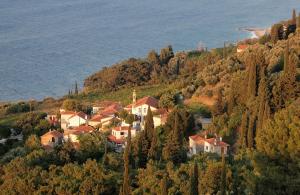
The oldest church within the village is the small chapel of Saint Constantine in Upper Agios Konstantinos, from which the settlement likely took its name.
A 1792 will, preserved in the Diocese of Samos and originating from Vronta Monastery, mentions a certain “Neilos the hieromonk, the chanter at Saint Constantine” (in the orthography of the original).
This chapel functioned as a metochi (dependency) of the Vronta Monastery.
The main church of Upper Agios Konstantinos is dedicated to the Dormition of the Virgin Mary and is celebrated on August 15 with the traditional dish of the “feast” — made with coarse wheat and goat meat.
The church was built between 1923 and 1926 on the ruins of a previous one, whose bell tower still survives and bears the inscription “1878.”
The construction was significantly funded by refugees from Asia Minor.
In the seaside settlement, the oldest church is Agia Paraskevi.
Beneath its wooden floor was the ossuary, until a separate cemetery was built in 1929 at the foot of the opposite hill.
In the 1880s, the village priest Panagiotis Marathokampitis (1849–1928) and local faithful funded a new, larger church — likely replacing an older, smaller one dedicated to Saint John the Baptist.
The new church was named “The Birth of Saint John the Baptist” (later “The Nativity of Saint John the Baptist”).
Within the village there is also the small chapel of the Virgin Mary Evangelistria.
 |  |  |


Add new comment